



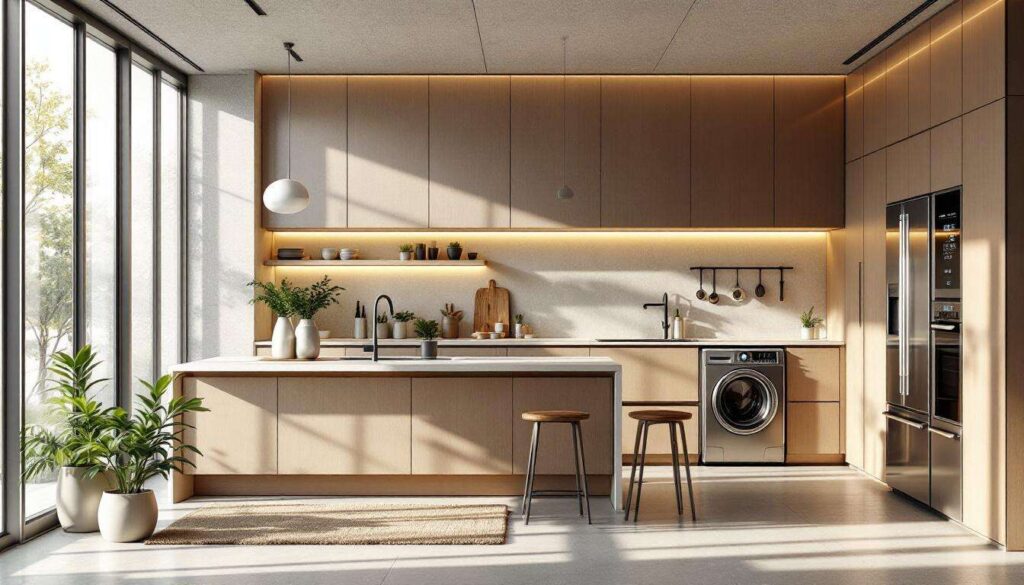
Modern households are experiencing a significant transformation as technology and sustainability converge to reshape how we interact with everyday appliances. From refrigerators that order groceries to washing machines that optimize water usage, the landscape of kitchen and utility room equipment is evolving rapidly. These innovations are not merely about convenience; they represent a fundamental shift in how we approach home management, energy consumption, and environmental responsibility. Understanding these emerging patterns helps homeowners make informed decisions when upgrading their living spaces.
Connected appliances: the future of kitchens and utility rooms
Smart connectivity revolutionizes daily routines
The integration of Internet of Things (IoT) technology has fundamentally altered the appliance industry. Connected devices now communicate with smartphones, tablets, and home automation systems to provide unprecedented control and monitoring capabilities. Refrigerators equipped with internal cameras allow users to check contents remotely while shopping, eliminating guesswork and reducing food waste. Ovens can be preheated from anywhere, and dishwashers send notifications when cycles complete.
These intelligent systems learn user preferences over time, adapting their operations to match household patterns. A smart washing machine might delay its cycle to take advantage of off-peak electricity rates, while a connected coffee maker prepares your morning brew as your alarm sounds. The convenience factor extends beyond simple remote control to create truly responsive home environments.
Voice control and seamless integration
Voice-activated assistants have become standard features in many modern appliances. Users can now issue commands to start, stop, or adjust settings without touching a single button. This hands-free operation proves particularly valuable when cooking or handling other tasks. The technology integrates with popular platforms like Amazon Alexa, Google Assistant, and Apple HomeKit, creating unified ecosystems where appliances work in concert.
- Voice commands for temperature adjustments and timer settings
- Recipe guidance through audio instructions
- Inventory tracking and automated shopping list creation
- Energy consumption reports delivered through smart speakers
This connectivity also enables manufacturers to push software updates directly to appliances, improving functionality and fixing issues without requiring service calls. As these technologies mature, they’re becoming essential considerations for anyone planning kitchen or utility room renovations.
The rise of sustainable and eco-friendly materials
Environmental consciousness drives material selection
Manufacturers are increasingly prioritizing sustainable materials in appliance construction. Recycled stainless steel, reclaimed plastics, and bio-based composites are replacing traditional materials that carry larger environmental footprints. These choices reflect growing consumer demand for products that align with ecological values without sacrificing performance or aesthetics.
Beyond the materials themselves, production processes are being reimagined to minimize waste and reduce carbon emissions. Companies are implementing closed-loop manufacturing systems where materials from old appliances are recovered and reintegrated into new products. This circular economy approach addresses the mounting concern over electronic waste while conserving natural resources.
Certifications and transparency
Third-party certifications now guide consumers toward genuinely sustainable options. Labels such as Energy Star, EPEAT, and Cradle to Cradle provide transparent information about environmental impact. Manufacturers are also publishing detailed sustainability reports that outline material sourcing, manufacturing practices, and end-of-life recycling programs.
| Certification | Focus Area | Key Benefit |
|---|---|---|
| Energy Star | Energy efficiency | Reduced utility costs |
| EPEAT | Environmental attributes | Lower environmental impact |
| Cradle to Cradle | Material health and recyclability | Circular economy support |
These material innovations complement the technological advancements that are making appliances smarter and more responsive to user needs.
The integration of smart technologies for optimal use
Artificial intelligence enhances performance
Machine learning algorithms are being embedded into appliances to optimize their operation automatically. Dishwashers now detect soil levels and adjust water usage accordingly, while dryers sense moisture content to prevent over-drying and fabric damage. These intelligent systems eliminate the guesswork that traditionally required manual adjustment of settings.
Refrigerators equipped with predictive maintenance capabilities can identify potential failures before they occur, alerting homeowners to schedule service proactively. This prevents food spoilage and costly emergency repairs. Cooking appliances analyze food types and weights to recommend optimal cooking times and temperatures, ensuring consistent results even for novice cooks.
Data-driven insights and personalization
Modern appliances collect and analyze usage data to provide valuable insights. Users can track their consumption patterns, identify inefficiencies, and receive personalized recommendations for improvement. A smart oven might suggest recipes based on ingredients detected in the connected refrigerator, while a washing machine could recommend maintenance schedules based on actual usage rather than arbitrary timelines.
- Customized cleaning cycles based on fabric types and soil levels
- Automated inventory management with expiration date tracking
- Energy usage analytics with cost projections
- Maintenance reminders based on actual wear patterns
These intelligent features work hand-in-hand with improved energy efficiency standards that are reducing the environmental impact of household operations.
The increase in energy efficiency of appliances
Advanced technologies reduce consumption
The latest generation of appliances achieves remarkable energy efficiency through innovative engineering. Inverter compressors in refrigerators and air conditioners adjust their speed continuously rather than cycling on and off, dramatically reducing electricity consumption. Induction cooktops transfer energy directly to cookware with minimal heat loss, cooking faster while using less power than traditional electric or gas ranges.
Heat pump technology is being incorporated into dryers and dishwashers, recovering and reusing thermal energy that would otherwise be wasted. These systems can reduce energy consumption by up to 50 percent compared to conventional models. Improved insulation materials and sealed systems minimize temperature fluctuations, allowing appliances to maintain optimal conditions with less energy input.
Measurable impact on utility costs
The financial benefits of energy-efficient appliances extend beyond lower monthly bills. Many utility companies offer rebates for purchasing qualifying models, and some regions provide tax incentives for energy-efficient home improvements. Over the typical lifespan of major appliances, these savings can amount to hundreds or even thousands of dollars.
| Appliance Type | Average Annual Savings | Payback Period |
|---|---|---|
| Refrigerator | $70-$100 | 3-5 years |
| Washing Machine | $45-$65 | 4-6 years |
| Dishwasher | $35-$50 | 5-7 years |
These efficiency improvements are being packaged in designs that prioritize user comfort and accessibility, making advanced technology available to broader audiences.
The growing importance of ergonomic and functional design
User-centered design principles
Ergonomic considerations are now central to appliance development. Manufacturers recognize that even the most technologically advanced device fails if it’s difficult or uncomfortable to use. Controls are being positioned at convenient heights, reducing the need for bending or reaching. Drawer-style dishwashers and refrigerators eliminate the strain of loading and unloading traditional models.
Touch interfaces with intuitive layouts replace complex button arrays, making operation straightforward for users of all ages and technical abilities. Visual feedback through LED displays and indicator lights provides clear status information at a glance. These design improvements make daily tasks less physically demanding while enhancing overall user satisfaction.
Adaptability and universal accessibility
Modern appliances increasingly accommodate diverse user needs through adjustable features and universal design principles. Raised dishwashers can be installed at heights that eliminate bending, while front-loading washers with pedestals bring controls to comfortable levels. Audible alerts supplement visual indicators for users with vision impairments, and tactile markings help identify controls.
- Adjustable shelving and storage configurations
- Contrast-enhanced displays for improved visibility
- Single-handed operation capabilities
- Clear, simplified control interfaces
These thoughtful design elements ensure that advanced appliance technology remains accessible and beneficial for all household members, regardless of physical abilities or technical expertise.
The convergence of connectivity, sustainability, intelligence, efficiency, and ergonomic design is fundamentally reshaping kitchen and utility room appliances. Connected devices provide unprecedented control and convenience while learning from user behavior to optimize performance. Sustainable materials and manufacturing processes address environmental concerns without compromising quality. Artificial intelligence and smart technologies enhance functionality through automation and personalization. Energy-efficient systems deliver substantial cost savings alongside reduced environmental impact. Ergonomic designs ensure these advanced features remain accessible and comfortable for diverse users. Together, these trends represent a holistic approach to appliance development that balances technological innovation with practical needs and environmental responsibility, creating home environments that are smarter, more sustainable, and more responsive to the people who inhabit them.